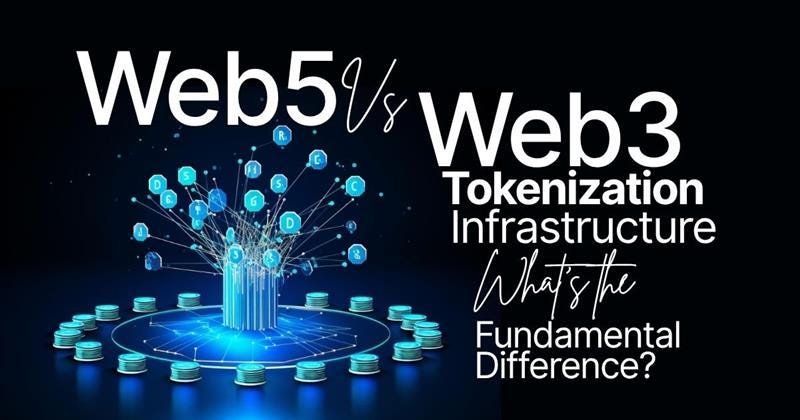
Web5 vs Web3 Tokenization Infrastructure: What’s the Fundamental Difference?
Explore the key differences between Web5 and Web3 tokenization infrastructure. Learn how Web5 offers user-controlled identity, secure cross-platform assets, and greater flexibility for modern digital asset management.
Tokenization is transforming digital ownership. It allows businesses and investors to represent real-world and digital assets as tokens, making transactions faster, more secure, and transparent. Web3 and Web5 both enable tokenization, but they differ in approach and scope. Understanding the differences helps businesses choose the right system for managing digital assets.
Web3 Tokenization InfrastructureWeb3 tokenization infrastructure is based on decentralized blockchain networks. Assets like digital art, real estate, and financial instruments can be converted into tokens that are traded across decentralized platforms. Web3 reduces reliance on central authorities by allowing users to manage tokens through decentralized applications and smart contracts. Transactions are secure, traceable, and global.
Web3 also supports fractional ownership, making high-value assets accessible to smaller investors. This opens new opportunities and creates liquidity in markets that were previously difficult to enter. The infrastructure is well-established, giving businesses a reliable framework for tokenized asset management.
Web5 Tokenization InfrastructureWeb5 tokenization infrastructure builds on Web3 by adding full user control over identity and personal data. Users maintain ownership of their digital assets, identity, and information without depending on centralized services. This creates a more secure and user-centric system.
Web5 integrates decentralized identifiers and verifiable credentials, enabling identity management across platforms. Tokens can move between applications while keeping ownership and security intact. The system is designed for interoperability, allowing assets, data, and identity to work together seamlessly. This makes Web5 a flexible and future-ready framework for digital asset management.
Key Differences Between Web3 and Web5The differences between Web3 and Web5 are mainly about control, identity, and flexibility. Web3 gives users control over tokens but may still rely on external services for identity and data. Web5 provides complete ownership of both assets and personal information. Web3 wallets can depend on centralized systems, whereas Web5 uses decentralized identifiers and verifiable credentials for secure identity management. Tokens in Web3 are often limited to a single blockchain, while Web5 tokens can move across platforms. Web3 transparency can expose user data, but Web5 focuses on private, user-controlled data storage.
Features of Web5 Tokenization InfrastructureWeb5 tokenization infrastructure combines security, flexibility, and user control. Users retain ownership of their digital identity, which eliminates dependence on central authentication systems. Tokens created in Web5 environments can be used across multiple platforms, increasing usability. The combination of blockchain security, decentralized identifiers, and encrypted storage ensures both assets and personal information remain safe. High-value assets can be divided into smaller portions, allowing more investors to participate. Users also control what information they share and with whom, giving businesses and individuals greater control over digital interactions.
Potential Use CasesWeb5 tokenization infrastructure has practical applications across industries. Digital artists can tokenize work while maintaining control over usage and ownership. Real estate can be divided into tokenized shares, simplifying investment and trading while keeping ownership records secure. Financial instruments like stocks and bonds can be tokenized and transferred across platforms efficiently, improving compliance and transparency. Users can safely monetize personal data or share credentials while retaining privacy. Gaming and virtual assets also benefit from Web5, as in-game items can move across platforms without losing ownership. These use cases show how Web5 enables broader access, streamlined operations, and new business opportunities.
Benefits of Web5 Tokenization InfrastructureAdopting Web5 tokenization infrastructure offers clear advantages. Users retain full ownership of assets, identity, and data, reducing reliance on third parties. Tokens are interoperable across multiple platforms, giving businesses and individuals flexibility. Security and privacy are enhanced through encryption and decentralized identity management. Fractional ownership allows smaller investors to access high-value assets, expanding participation. Automated smart contracts and cross-platform capabilities reduce operational complexity. Transparent blockchain records and secure identity verification increase confidence among users and investors. Web5 infrastructure provides businesses with a modern, scalable framework for managing digital assets efficiently.
ConclusionWeb3 and Web5 both offer secure frameworks for digital asset management. Web3 focuses on decentralized token ownership, while Web5 enhances control with user-managed identity, private data storage, and cross-platform interoperability. Businesses looking to implement next-generation tokenization can benefit from professional Web 5 tokenization infrastructure solutions. Partnering with a reliable Web5 tokenization infrastructure Company ensures scalable, secure, and user-friendly systems that unlock the full potential of digital assets.
Web5 vs Web3 Tokenization Infrastructure: What’s the Fundamental Difference? was originally published in Coinmonks on Medium, where people are continuing the conversation by highlighting and responding to this story.