
One of Wall Street’s Top Strategists No Longer Trusts Bitcoin | US Crypto News
Welcome to the US Crypto News Morning Briefing—your essential rundown of the most important developments in crypto for the day ahead.
Grab a coffee — because this isn’t about price charts, ETF flows, or the next halving narrative. It’s about something far more uncomfortable: whether Bitcoin, as it exists today, is built to last.
Crypto News of the Day: Why One of Wall Street’s Biggest Bitcoin Bulls Just Walked AwayA quiet but consequential shift is unfolding in institutional crypto thinking. Christopher Wood, global head of equity strategy at Jefferies and one of Wall Street’s most closely followed market strategists, has removed Bitcoin entirely from his flagship model portfolio.
The Jeffries executive did not cite price volatility but instead cited doubts about the asset’s long-term durability.
Wood has cut a 10% Bitcoin allocation from Jefferies’ model portfolio and reallocated it evenly to physical gold and gold-mining stocks.
The decision was outlined in the latest edition of his Greed & Fear newsletter, where Wood pointed to the long-term threat posed by advances in quantum computing to Bitcoin’s security and store-of-value thesis.
“The once-distant threat of quantum computing has prompted one of the most closely followed market strategists to walk away from Bitcoin,” Bloomberg reported, citing Wood in the newsletter and highlighting how a theoretical risk is now entering mainstream portfolio construction.
Wood was an early institutional supporter of Bitcoin, first adding the asset to his model portfolio in December 2020 amid pandemic-era stimulus and fears of currency debasement.
He later raised the exposure to 10% in 2021. Notably, Bitcoin has since surged by approximately 325% since the initial allocation compared with gold’s 145% gain. Notwithstanding, Wood says performance is no longer the point.
In his view, quantum computing weakens the argument that Bitcoin can function as a dependable, multi-decade store of value, particularly for pension-style, long-term investors.
“There is growing concern in the Bitcoin community that quantum computing could only be a few years away rather than a decade or more,” Wood wrote.
Indeed, Bitcoin’s security rests on cryptographic systems that make it practically impossible for today’s computers to derive private keys from public ones.
However, cryptographically relevant quantum computers (CRQCs) could collapse that asymmetry. This could allow attackers to reverse-engineer private keys in hours or days.
Quantum Risk, Governance, and the Institutional Rethink of BitcoinThe debate exposes a widening divide between capital allocators and developers. Nic Carter, a partner at Castle Island Ventures, captured this tension in a December post.
The discrepancy between capital and developers on this issue is massive. Capital is concerned and looking for a solution. Devs are mainly in complete denial. Inability to even acknowledge quantum risk is already weighing on the price.
— nic carter (@nic_carter) December 18, 2025Nevertheless, governance is at the heart of the issue. Proposed solutions, including burning quantum-vulnerable coins or forcing a migration to post-quantum cryptography, raise uncomfortable questions about property rights and rule changes.
The crypto community is debating the threat of quantum computers to the blockchain, specifically for Bitcoin.
I will explain to you what the threat is.
Modern blockchains rely on asymmetric cryptography.
The following principles apply:
▪️A private key is a secret number… pic.twitter.com/0DUQkSWfx4
Jefferies noted that while Bitcoin has undergone forks before, confiscating or invalidating coins could undermine the very principles that give the network credibility.
Jefferies also highlighted that large portion of the Bitcoin supply could be vulnerable in a quantum scenario. These include:
- Satoshi-era holdings stored in Pay-to-Public-Key (P2PK) addresses
- Lost coins, and
- Addresses reused across multiple transactions
Altogether, this is potentially millions of BTC.
Recent analysis from Coinbase has echoed some of those concerns. Coinbase Head of Investment Research David Duong said quantum computing poses long-term risks beyond private key security, potentially affecting Bitcoin’s economic and security models.
While stressing that current quantum technology is far from breaking Bitcoin today, Duong warned that around 6.5 million BTC could be exposed to long-range quantum attacks. This makes migration to post-quantum cryptography essential, if still years away.
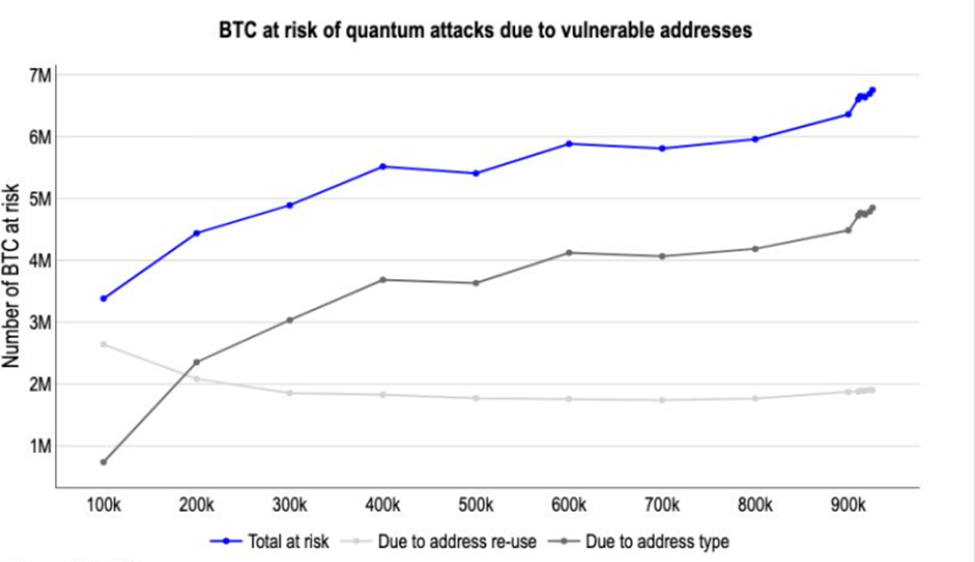 Bitcoin At Risk of Quantum Attacks due to Vulnerable Addresses. Source: David Duong on LinkedIn
Meanwhile, Wood notes that the long-term questions raised by quantum computing are only long-term positive for gold. This stance hinges on gold’s history as a tested hedge free from technological and governance uncertainty.
The move marks a broader shift in institutional thinking. Cyber Capital founder and CIO Justin Bons claims Bitcoin could collapse at any time after 2033. However, Bons cites shrinking miner subsidies post-halvenings and low transaction fees.
BTC will collapse within 7 to 11 years from now!
First, the mining industry will fall, as the security budget shrinks
That is when the attacks begin; censorship & double-spends
Core will then have to increase inflation beyond 21M, splitting the chain & that will be the end!