
HNUT Meme Coin Collapses 99% on Solana, PeckShield Flags Bundled Rug Pull
Blockchain security firm PeckShield has flagged HNUT, a Solana-based meme coin themed “Holly The Squirrel,” after the token collapsed by 99% shortly after launch.
It marks another apparent bundled rug pull in the fast-moving Solana meme coin ecosystem.
HNUT Raises Rug Pull Fears After 99% CrashIn a post shared on X (Twitter), PeckShield reported that HNUT on Solana has plummeted by 99%, indicating an abrupt price collapse that has erased nearly all of the token’s market value.
#PeckShieldAlert #rugpull $HNUT on #Solana has plummeted -99%. #meme pic.twitter.com/hamEanpbOX
— PeckShieldAlert (@PeckShieldAlert) December 30, 2025HNUT price fell from an all-time high near $0.007 to effectively zero, with remaining liquidity of roughly $29,000 and a market capitalization of less than $1,400.
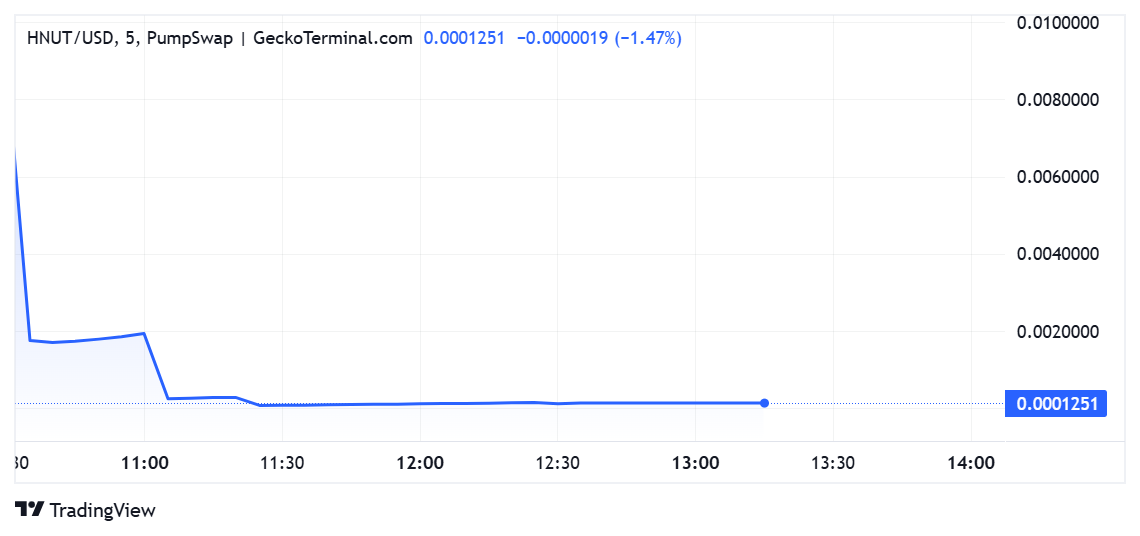 Holly The Squirrel (HNUT) Price Performance. Source: GeckoTerminal
The token was launched via Solana-based Pump.fun under this contract address. This launchpad has increasingly come under scrutiny in late 2025 for enabling quick-cycle meme coin launches with minimal safeguards.
On-chain analysis surrounding HNUT revealed heavy bundled transaction activity shortly after launch.
According to reports, approximately 78% of early trading activity involved bundled transactions. This phenomenon is commonly associated with insider supply control, where multiple wallets coordinate to concentrate tokens before executing a rapid sell-off.
Early On-Chain Warnings Highlight the Growing Cost of Ignoring Red FlagsAccording to on-chain investigator Specter, signs were visible on-chain, and the structure of the launch made the outcome predictable for experienced traders.
The chart clearly shows it was a bundled.
Anybody who lost money to this is fo*l pic.twitter.com/Pz4I8dV8m8
Indeed, warnings about HNUT surfaced even before the collapse. Crypto Scam Hunter issued a scam alert a day earlier, flagging bundled on-chain behavior and supply concentration as red flags.
The post urged traders to stay away, citing transaction logs that showed coordinated transfers from multiple wallets into a single address, often a precursor to liquidity drains.