
Is Bitcoin Already in a Bear Market? Fidelity Chief Raises Concerns
Bitcoin has largely ignored what should have been supportive macro signals. US CPI cooled to 2.7% in December, strengthening rate-cut expectations, yet Bitcoin failed to respond. Instead of attracting fresh capital, the price stalled while money rotated elsewhere.
That disconnect is why the Bitcoin bear market discussion is resurfacing.
Fidelity’s Director of Global Macro, Jurrien Timmer, recently warned that Bitcoin may have already ended its latest four-year cycle in October, both in price and time. The on-chain and market data since then increasingly support that view.
Data Signals Suggest Bitcoin May Already Be in a Bear MarketMultiple independent indicators now point to the same conclusion: capital is retreating, conviction holders are selling, and Bitcoin is absorbing risk without real demand.
Stablecoin Inflows Have Collapsed Since the Cycle PeakStablecoin inflows often act as dry powder for crypto rallies. That fuel has vanished.
Total exchange inflows for ERC-20 stablecoins peaked at around 10.2 billion on August 14. By December 24, inflows had fallen to roughly 1.06 billion, a drop of nearly 90%.
Want more token insights like this? Sign up for Editor Harsh Notariya’s Daily Crypto Newsletter here.
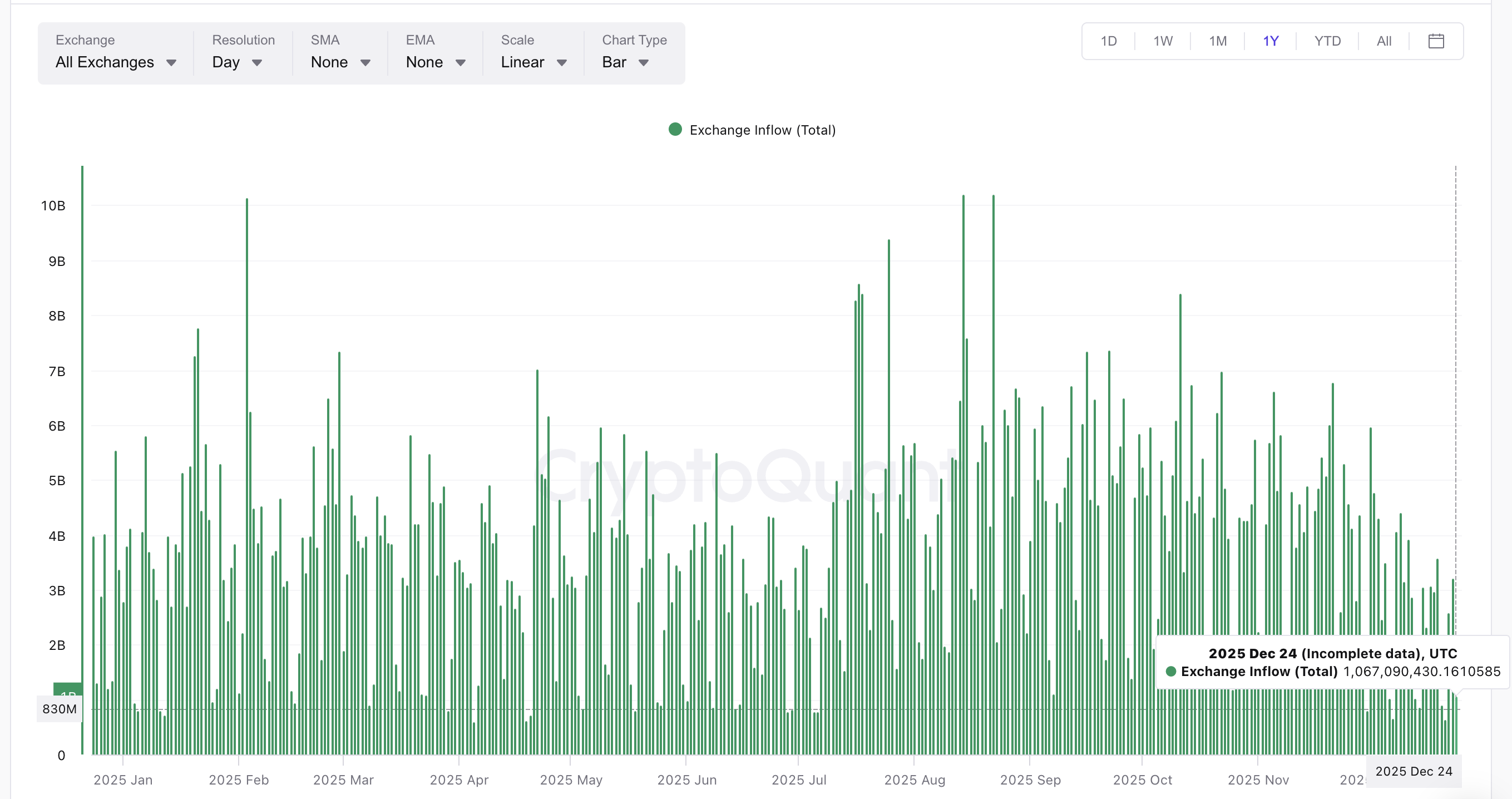 Stablecoin Flows: CryptoQuant
That August inflow peak closely preceded Bitcoin’s October high above $125,000, the same period Timmer identified as the likely cycle top.
While I remain a secular bull on Bitcoin, my concern is that Bitcoin may well have ended another 4-year cycle halving phase, both in price and time. If we visually line up all the bull markets (green) we can see that the October high of $125k after 145 months of rallying fits… pic.twitter.com/Uxg9DTccnt
— Jurrien Timmer (@TimmerFidelity) December 18, 2025Since then, fresh capital has failed to return, reinforcing the idea that distribution replaced accumulation after the peak.
Long-Term Holders Have Turned Aggressive SellersConviction holders are behaving differently after October.
Bitcoin long-term holder net position change flipped negative shortly after the cycle high. Selling accelerated from roughly 16,500 BTC per day in late October to around 279,000 BTC recently. That is an increase of more than 1,500% in daily distribution pressure.
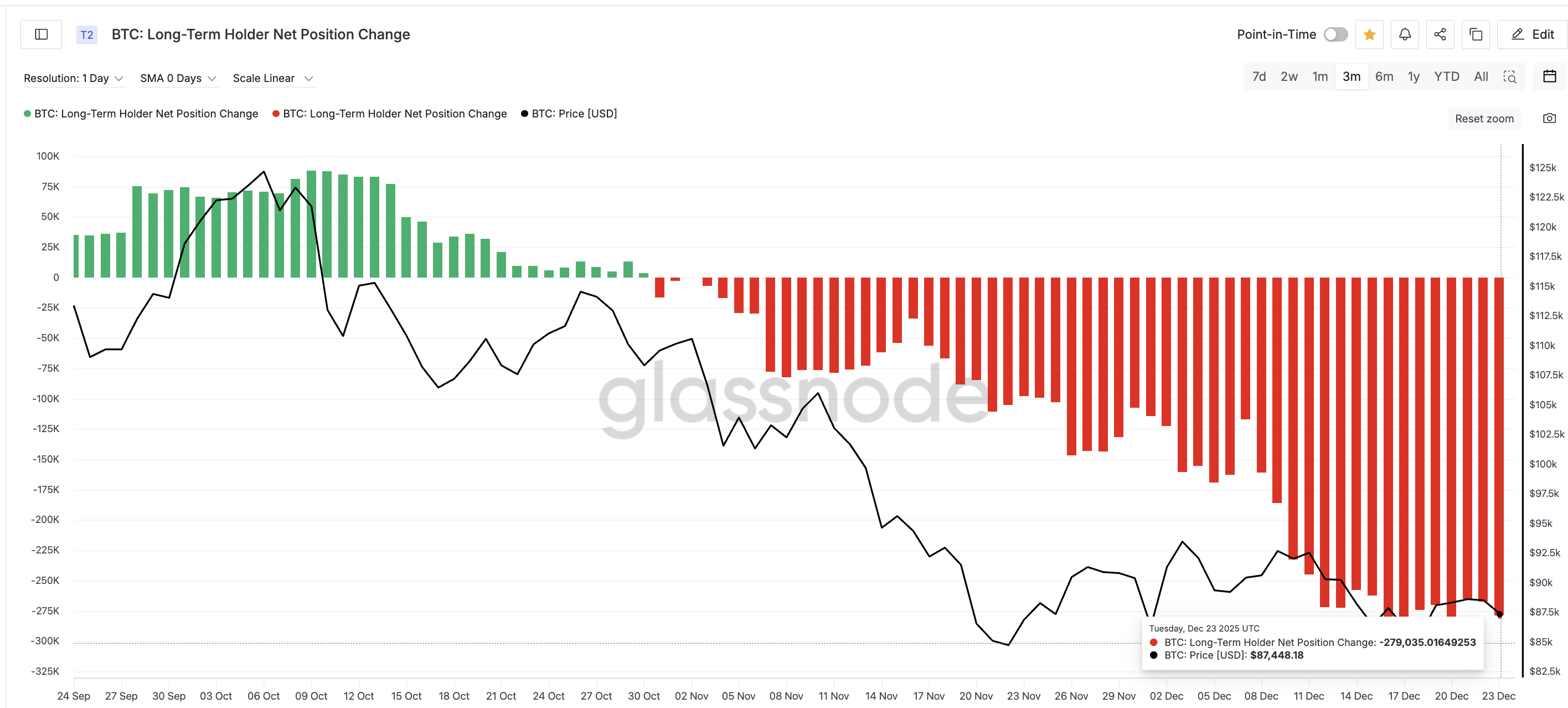 Long-Term BTC Holders Dumping: Glassnode
This aligns directly with Timmer’s thesis that the four-year halving cycle phase likely ended in October. Long-term holders appear to agree, reducing exposure rather than defending price.
Bitcoin Dominance Is Rising, But Not for Bullish ReasonsBitcoin dominance has climbed back toward 57–59%, but this is not a risk-on signal.
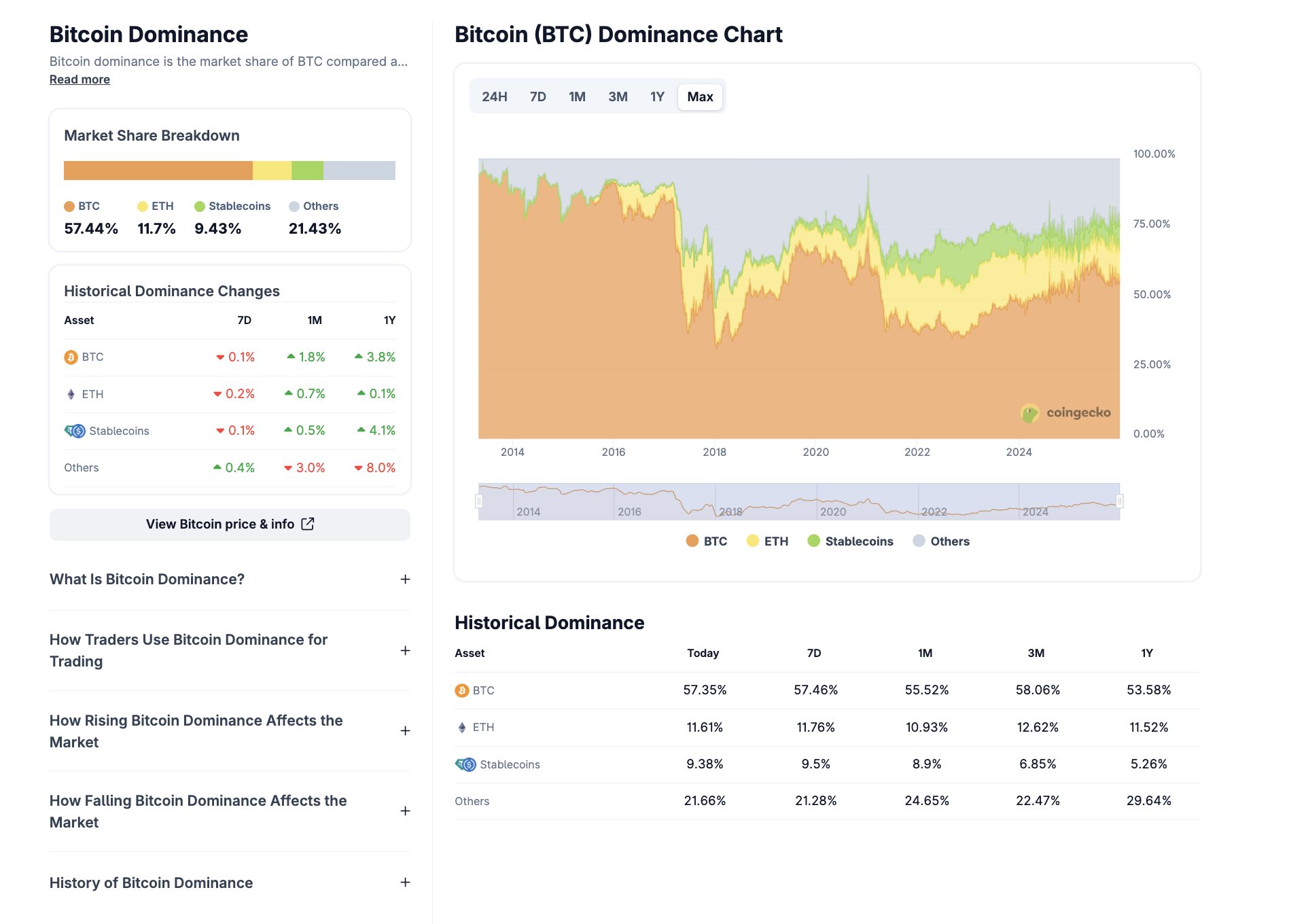 BTC Dominance: CoinGecko
After the softer CPI print, capital did not rotate into Bitcoin. Instead, it flowed into traditional hedges. Over the past year, silver has rallied by over 120%, while gold is up roughly 65%. At the same time, broader crypto markets have lagged badly.
If you invested $10,000 in each asset at the start of 2025, you’d have:
Silver → $23,000
Gold → $16,500
Copper → $13,500
Nvidia → $13,450
Nasdaq → $12,000
S&P 500 → $11,600
BTC → $9,400
ETH → $8,800
Altcoins → $5,800