
Why 86% of All Crypto Token Failures Happened in 2025
The crypto market experienced an unprecedented wave of project collapses in 2025, with more than 11.6 million tokens failing in a single year, according to new data from CoinGecko.
The figure represents 86.3% of all cryptocurrency failures recorded since 2021, making 2025 the most destructive year for token survivability in the industry’s history.
Token Creation Exploded—Survivability Collapsed, CoinGecko Report ShowsCoinGecko’s findings highlight a structural breakdown in the token economy, driven by the explosive creation of projects, meme coin saturation, and heightened market turbulence.
In total, 53.2% of all cryptocurrencies tracked on GeckoTerminal are now inactive. The vast majority of failures have clustered in the past two years.
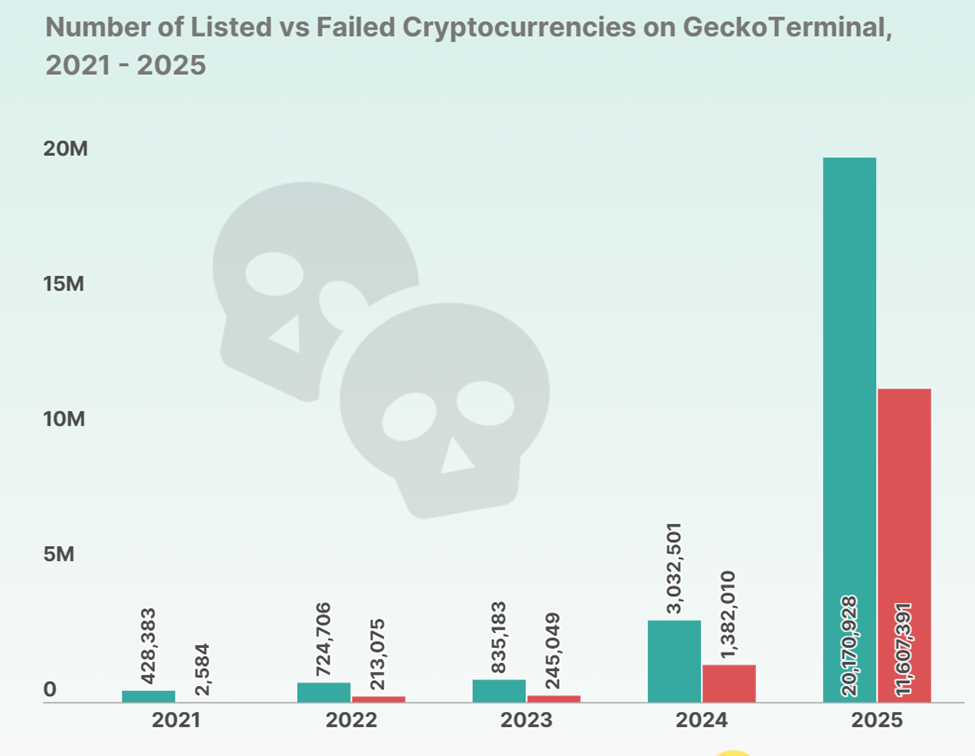 53.2% Cryptocurrencies Have Died Since 2021. Source: CoinGecko
Between 2021 and 2025, the number of listed cryptocurrency projects surged from 428,383 to nearly 20.2 million. While the rapid growth reflected increasing accessibility to token creation tools, it also led to severe market saturation.
The annual breakdown of failures illustrates the scale of the shift. In 2021, just 2,584 tokens failed. That number jumped to 213,075 in 2022 and 245,049 in 2023.
The situation escalated sharply in 2024, when 1,382,010 tokens collapsed. However, 2025 dwarfed all previous years, with 11,564,909 failed tokens.
Number of Failed Cryptocurrencies by Year
2021: 2,584 tokens
2022: 213,075 tokens
2023: 245,049 tokens
2024: 1,382,010 tokens
2025: 11,564,909 tokens
What's one project that you think will succeed?
Together, 2024 and 2025 accounted for more than 96% of all crypto token failures since 2021, reflecting how recent market conditions fundamentally altered token survivability.
CoinGecko’s methodology focused exclusively on cryptocurrencies that had recorded at least one trade and were listed on GeckoTerminal before becoming inactive.
Tokens with zero trading activity were excluded, while only graduated Pump.fun tokens were included, reinforcing the credibility of the dataset.
Q4 2025 Marked the Breaking Point Amid Meme Coin Saturation and “Crime Szn” WoesThe collapse accelerated dramatically in the final months of the year. Q4 2025 alone saw 7.7 million token failures, representing 34.9% of all recorded collapses over the five years.
This surge coincided with the October 10 liquidation cascade, during which $19 billion in leveraged positions were wiped out within 24 hours, marking the largest single-day deleveraging event in crypto history.
The shock exposed vulnerabilities across thinly traded tokens, many of which:
- Lacked sufficient liquidity or
- Committed market participants to survive extreme volatility.
CoinGecko noted that the sharp decline in survivability was particularly pronounced within the meme coin sector, which had expanded quickly throughout the year.
The rise of easy-to-use launchpads played a central role in the wave of failures. Platforms like Pump.fun have significantly reduced technical barriers, allowing nearly anyone to launch a token within minutes.
This is huge.
The 11.5M token failures in 2025 exposes a policy vacuum.
1️⃣ Zero regulation on launching a token. Anyone can deploy one in minutes.
2️⃣ Platforms like https://t.co/3tm9tPLONE massively lower friction, enable mass launches, and take no accountability for outcomes.…
While this democratized experimentation, it also flooded the market with low-effort projects lacking long-term viability.
DWF Labs executive Andrei Grachev described the environment as a crime season, pointing to systemic pressures facing both founders and investors.
Basically it created a "crime szn", failure rate is so high, which affects founders and investors – hard to get attention, hard to get liquidity, hard to find a market fit.
Market is BTC, blue chips and gambling.
Retail liquidity is being burn
Liquidity wars are ongoing https://t.co/o5EACJJ6Ft