
Turkmenistan Legalizes Crypto Mining in Rare Economic Shift
Turkmenistan legalized crypto mining and exchanges on January 1, 2026, marking one of the most significant policy shifts by the tightly controlled Central Asian state in decades.
President Serdar Berdimuhamedow signed the law. This brings virtual assets under civil law and introduces a licensing regime overseen by the central bank.
Even Closed-Door Economies Can’t Disregard CryptoThe move opens a narrow but notable door for crypto activity in a country long known for isolation, strict capital controls, and heavy state oversight.
Yet, the feasibility of mining operations remains questionable in a country where the government tightly regulates internet access.
Turkmenistan legalizes crypto under new Virtual Assets law
Turkmenistan has passed a new Law on Virtual Assets, effective January 1, 2026, legalizing cryptocurrency mining and trading for the first time. The law was signed by President Serdar Berdimuhamedov on November 28, 2025,… pic.twitter.com/NNrZKi3e9T
Turkmenistan has historically ranked among the world’s most closed nations. The government maintains severe limits on media, travel, and foreign investment. The new law fits a pattern of cautious, state-led reforms rather than liberalization.
Last year, the government introduced electronic visas to ease entry for foreigners. Now, crypto mining appears positioned as another tightly managed tool to attract capital and technical expertise without loosening political control.
Officials have framed the legislation as an economic modernization effort rather than a financial revolution. Licensing requirements, central bank oversight, and payment restrictions ensure the state retains full control over the sector.
"Putin doesn’t name buildings after himself," said @FranklinFoer.
"The only leaders in the world who do this are in places like Turkmenistan and Tajikistan. There’s a tin-pot dictator quality to what [Trump is] doing and how he’s afflicting his insecurities on the world." pic.twitter.com/s4kfBJqcOB
Turkmenistan’s economy depends heavily on natural gas exports, with China as its primary buyer. Crypto mining offers a potential way to monetize excess energy capacity. It will also diversify revenue streams beyond hydrocarbons.
At the same time, the decision arrives as Russia tightens regulation at home while remaining one of the world’s largest mining hubs.
Moscow has pushed mining into formal, taxed channels and restricted operations in power-stressed regions.
Turkmenistan is not a formal ally of Russia, maintaining a policy of permanent neutrality.
Still, the law aligns with a broader Eurasian trend to expand mining capacity outside the United States, which remains the dominant destination for large-scale industrial miners.
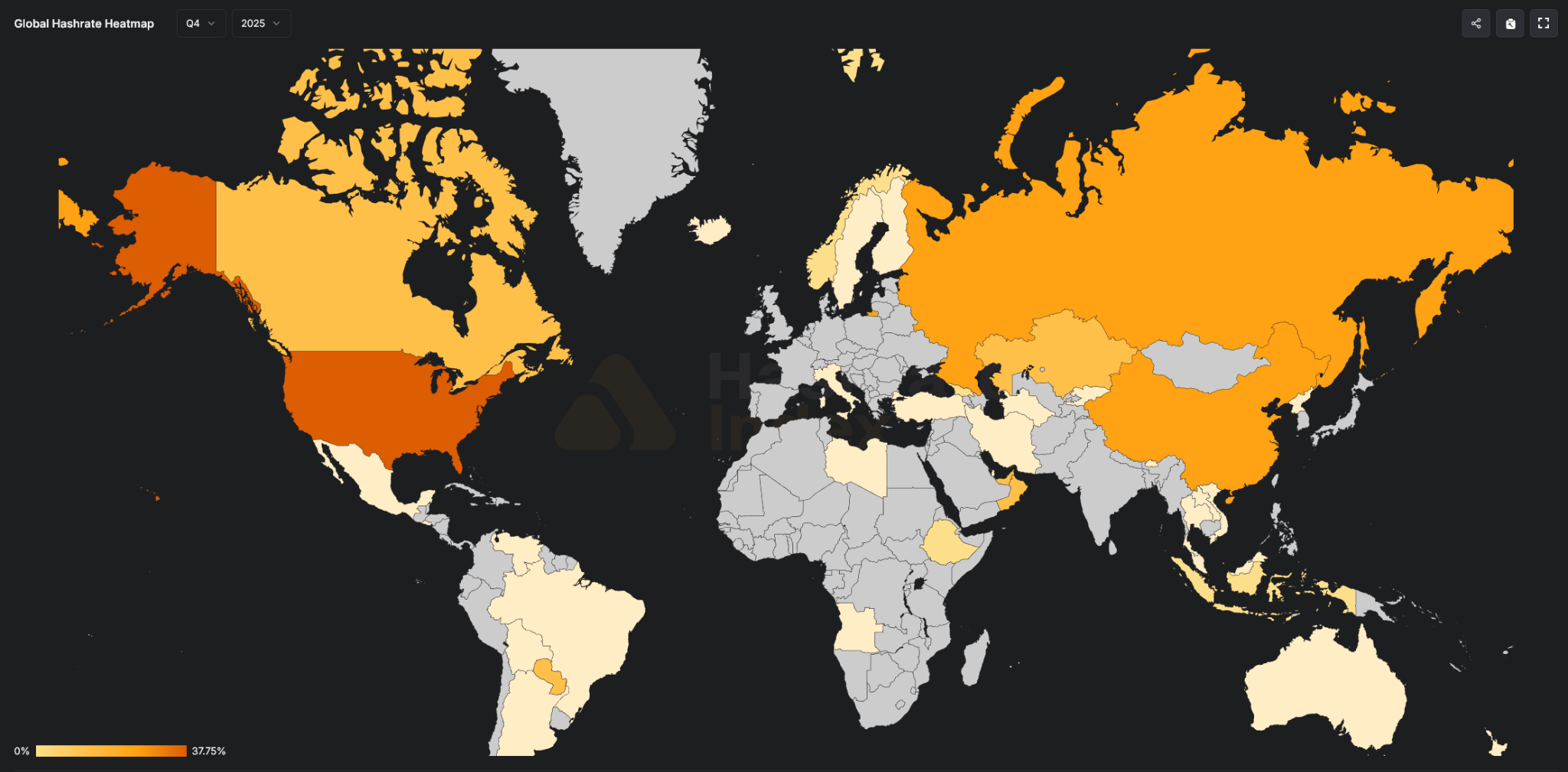 Global Crypto Mining Hashrate Map. Source: Hashrate Index
Despite the headline shift, constraints are clear. Crypto cannot be used for payments, exchanges will operate under strict licensing, and censorship-heavy internet controls remain unchanged.
As a result, Turkmenistan’s mining sector is likely to develop slowly and selectively.
The post Turkmenistan Legalizes Crypto Mining in Rare Economic Shift appeared first on BeInCrypto.