
Michael Saylor Warns on Bitcoin Protocol Drift as Quantum Risk Enters the Mainstream
MicroStrategy executive Michael Saylor warns that the greatest risk to Bitcoin is ambitious opportunists advocating protocol changes.
The remark comes just as Coinbase and the Ethereum network make moves to address one of Bitcoin’s most existential long-term threats: quantum computing.
Bitcoin’s Quantum Dilemma Puts Protocol Change Debate Back in FocusThe MicroStrategy co-founder framed protocol ossification as Bitcoin’s primary defense. According to Michael Saylor, internal attempts to “improve” the network pose a greater danger than external technological threats.
The greatest risk to Bitcoin is ambitious opportunists advocating protocol changes.
— Michael Saylor (@saylor) January 24, 2026This remark highlights Bitcoin’s role as neutral digital money amid debates like the BIP-110 soft fork proposal.
BIP-110, gaining 2.38% node support as of January 25, 2026, aims to temporarily cap transaction data (for instance, OP_RETURN at 83 bytes) to combat “spam” from non-monetary uses.
BIP-110 activates by September 2026. The clock is ticking.
After 3 years of inscriptions consuming 37% of block space with no action, this mechanism doesn't ask permission.
I'm tracking miner signaling and node adoption live: https://t.co/QUj2TvhQAR
Full breakdown in Bitcoin… pic.twitter.com/Ddh8e8d4hs
The discussion sparks a community split between purists who favor Bitcoin Knots and those who use Bitcoin Core for broader applications.
Some developers cite concerns about rushed or politically motivated changes, while others highlight that ignoring emerging risks could itself become a liability.
That tension is now coming into sharper focus as Coinbase announces the formation of an independent advisory board dedicated to quantum computing and blockchain security.
Coinbase Establishes Independent Advisory Board on Quantum Computing and Blockchain.
Possible @LindellYehuda doesn't know that @Conste11ation has already demonstrated Quantum Resistant Network to the United States Federal Government via IRON SPIDR.
One of the IRON SPIDR… pic.twitter.com/39YUwtocVi
The board will study how future advances in large-scale quantum machines could threaten Bitcoin’s cryptographic foundations. They will publish public research, risk assessments, and technical guidance for the broader ecosystem.
At the heart of the concern is elliptic-curve cryptography (ECC), which underpins Bitcoin’s ECDSA and Schnorr signatures.
In theory, a sufficiently powerful quantum computer running Shor’s algorithm could derive private keys from public keys, enabling attackers to forge transactions or drain exposed wallets.
While such machines remain at least 5 years away, the long lead time required for safe protocol transitions has made quantum resilience a growing priority.
No, quantum computers won't break Bitcoin in the near future. We'll keep observing their evolution.
Yet, making thoughtful changes to the protocol (and an unprecedented migration of funds) could easily take 5 to 10 years.
We should hope for the best, but prepare for the worst.
Coinbase’s advisory board brings together leading figures from cryptography and quantum research, including:
- Stanford professor Dan Boneh
- University of Texas quantum theorist Scott Aaronson
- Ethereum Foundation researcher Justin Drake, and
- EigenLayer founder Sreeram Kannan.
According to Coinbase, the board will operate independently and publish position papers on the state of quantum computing.
They will also issue guidance to developers and institutions, and respond in real time to breakthroughs in the field.
Bitcoin’s Quantum Conversation Shifts From Theory to Engineering RealityThe initiative reflects a broader shift in how the Bitcoin development community is approaching the issue.
Data from 2025 shows a notable rise in quantum-related discussions on Bitcoin mailing lists, with more than 10% of technical communications now touching on post-quantum security. Notably, this is after years of near silence.
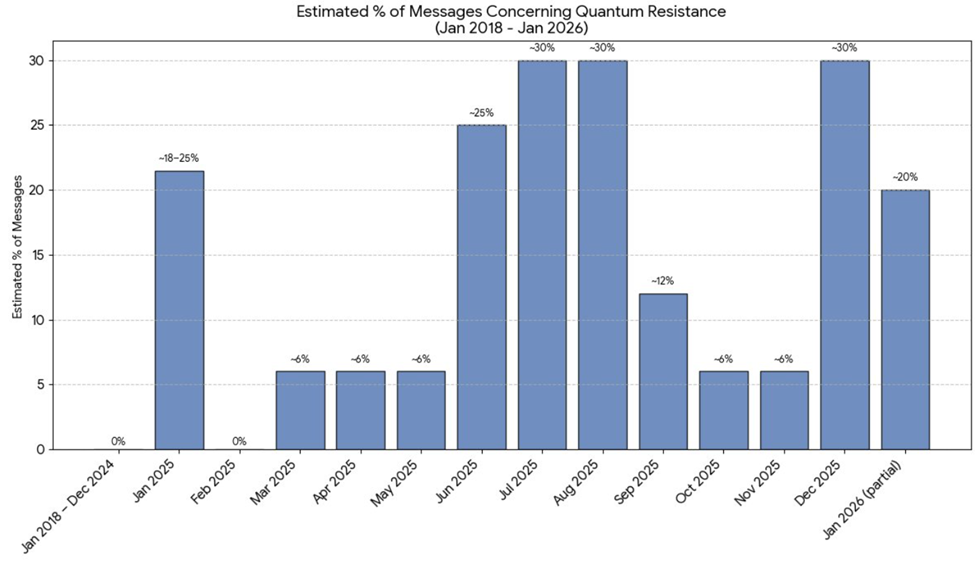 Estimated Percentage of Messages Concerning Quantum Resistance. Source: Willy Woo on X
The conversation has moved beyond abstract hypotheticals to concrete engineering questions, including how Bitcoin could migrate from ECC to post-quantum signature schemes through soft forks without disrupting the network.
ANALYSIS: Bitcoin dev response to quantum risks started in Jan 2025 and accelerated mid year, we also saw the first the Quantum Bitcoin Summit in July in SF.
IMO slow on the uptake, but it's now accelerating quickly
[Bitcoin Dev mailing list] pic.twitter.com/IYWTn2JBis
Despite this momentum, most researchers caution against rushing protocol changes. The prevailing view favors waiting for post-quantum cryptography standards from bodies like NIST to mature fully. This is as opposed to forcing premature upgrades that could introduce new vulnerabilities.
In that sense, Coinbase’s move is being framed as preparation rather than panic. It is an attempt to ensure that Bitcoin and other blockchains have credible migration paths long before quantum attacks become practical.
The contrast with Ethereum is also becoming more pronounced. The Ethereum Foundation recently declared post-quantum security a top strategic priority. With this, they are:
- Launching dedicated teams
- Funding cryptographic research, and
- Running live post-quantum devnets.
Ethereum representatives now sit on Coinbase’s advisory board, highlighting how quantum readiness is increasingly seen as an inter-chain, industry-wide challenge.
Today marks an inflection in the Ethereum Foundation's long-term quantum strategy.
We've formed a new Post Quantum (PQ) team, led by the brilliant Thomas Coratger (@tcoratger). Joining him is Emile, one of the world-class talents behind leanVM. leanVM is the cryptographic…
As quantum research accelerates and institutions take a more active role in future-proofing crypto infrastructure, that balance may prove harder to maintain.
The post Michael Saylor Warns on Bitcoin Protocol Drift as Quantum Risk Enters the Mainstream appeared first on BeInCrypto.