
Khamenei market meltdown on Kalshi shows how prediction markets still can’t decide what ‘counts’
For a platform that insists its rules were “clear from the outset,” Kalshi has spent the last several days explaining itself over and over again, often in slightly different ways, after one of its most controversial markets imploded into confusion, anger, and mass reimbursements.
The Kalshi market in question asked a seemingly straightforward question: would Iran’s Supreme Leader, Ali Khamenei, leave office before a certain date? But when news broke that Khamenei had died amid escalating regional conflict, traders quickly discovered that “leave office” did not mean what many assumed it meant. Well, at least not on a CFTC-regulated exchange.
Instead of resolving to a clean YES, the market settled at the last traded price before confirmation of death, triggering a cascade of backlash from traders who believed they had correctly predicted the outcome. Kalshi, for its part, insists it simply followed the rules. Critics say the episode reveals a platform that barely understands how its own policies land with users.
Reposting because my other message was unclear:
We settled the market to last traded price before time of death (per our rules). All positions, no matter when they were opened, got paid out on the last-traded price before his death.
On top of that, if you bought a position…
And hovering over the whole mess is the shadow of unregulated rivals like Polymarket, whose anything-goes approach continues to fuel insider trading allegations, law-enforcement cases, and regulatory outrage.
‘We don’t settle on death’ – except when we kind of doKalshi’s market rules did, in fact, contain a “death carveout.” As the exchange reiterated repeatedly, markets are not supposed to allow users to directly profit from someone’s death, which is a restriction tied to Kalshi’s status as a federally regulated exchange overseen by the Commodity Futures Trading Commission (CFTC).
A clause from the market’s official rulebook stated that if a leader “leaves solely because they have died,” the market would resolve based on the last traded price prior to death, with the exchange or an outcome review committee stepping in if needed to determine a fair value.
Please note: A prior version of this clarification was grammatically ambiguous. As a customer service measure, Kalshi will reimburse lost value due to trades made between these clarifications.
MARKET RULES CLARIFICATION: If Ali Khamenei dies, the market will resolve upon the… https://t.co/FiXhEpMatQ
The clause became the centerpiece of Kalshi’s defense. In an earlier clarification post, the company wrote: “Kalshi does not offer markets that settle on death.” Another message explained, “If Ali Khamenei dies, the market will resolve based on the last traded price prior to confirmed reporting of death.”
Yet the problem was how many users clearly didn’t internalize what the “death carveout” meant in practice. To many traders, “leaves office” sounded binary. To Kalshi’s lawyers, it was anything but.
Kalshi CEO explains, re-explains, and re-re-explains Khamenei situationAs criticism mounted, Kalshi CEO Tarek Mansour took to X (multiple times) to clarify the company’s position, acknowledge frustration, and outline an unusually generous reimbursement plan.
“The market rules were not changed,” Mansour wrote in his latest post. “The death carveout and settlement based on last-traded-price were part of the published market rules from the outset.”
As an exchange, we resolve the market according to the rules, even when there is disagreement with the resolution. I understand many of you are frustrated about the Khamenei market, and I want to clear up a few things along with steps we have taken to improve:
The market rules… pic.twitter.com/4zs23E8QnM
He stressed that once military strikes on Iran began, Kalshi added a prominent “Green Box” warning to the user interface, not as a rule change, but as a visual highlight of existing terms. The distinction apparently mattered, Mansour argued, because altering settlement rules mid-market would undermine trust for both YES and NO holders.
“Some traders who held YES feel like they should have won,” he acknowledged. “But the rules clearly stated that the market would not settle to YES in the event of death.”
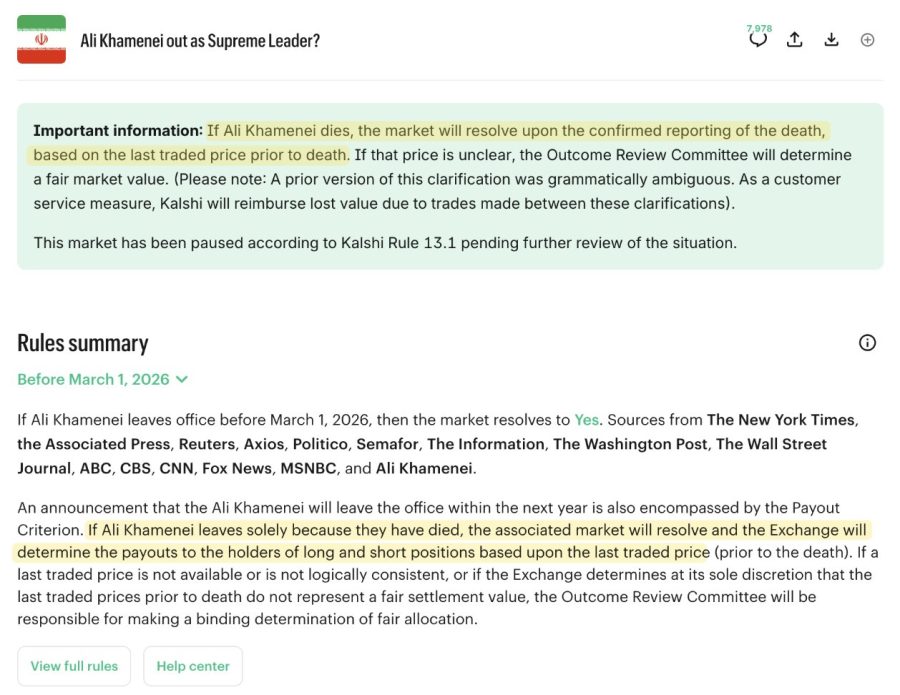 Kalshi’s market page displays a highlighted clarification that death would trigger settlement at the last traded price, not an automatic YES outcome. Credit: Kalshi via X
Then came the most striking admission. Kalshi decided that even being right wasn’t good enough if users felt blindsided.
“No trader lost money on this market,” Mansour wrote. Kalshi reimbursed all fees and covered all net trading losses out of pocket. Traders who sold at a loss were made whole; traders who didn’t recoup their entry cost during settlement were paid the difference. “No trader ended net-negative after our reimbursements.”
Kalshi, meanwhile, did.
“As a result,” Mansour conceded, “Kalshi incurred a substantial loss to make users whole.”
Chaos as a feature, not a bugThe fact that a regulated exchange felt compelled to fully unwind the financial consequences of a properly settled market says a lot about how brittle prediction-market UX still is. Kalshi insists the rules were visible, filed with regulators, and technically unambiguous. Users insist that whatever clarity existed on paper evaporated once real-world violence entered the picture.
In that sense, the Khamenei market joined a growing list of Kalshi controversies that have attracted regulatory scrutiny and media criticism. The platform has previously faced a formal CFTC complaint over a Super Bowl-related event contract, and lawmakers have repeatedly urged regulators to crack down on markets that touch death, war, or assassination, even indirectly.
Kalshi has responded by positioning itself as the responsible adult in the room ie. committed to compliance, allergic to sensationalism, and willing to eat losses rather than profit from tragedy.
Polymarket: the cautionary tale Kalshi can’t ignoreThe posture is easiest to understand when contrasted with Polymarket, which operates outside the CFTC’s regulatory framework and has repeatedly found itself at the center of scandal.
JUST IN: 