
CZ Dismisses Centralization Fears Amid Scrutiny Over Binance’s Grip on USD1 Stablecoin
Binance is making headlines on social media for multiple reasons. Among them, a Forbes report revealed that the exchange and its users control the overwhelming majority of USD1, a stablecoin issued by World Liberty Financial (WLFI).
With the WLFI venture linked to US President Donald Trump and his family, the disclosure has sparked debate over concentration risk, exchange influence, and the growing overlap between crypto markets and politics.
Binance’s USD1 Dominance Rekindles Debate Over Stablecoin CentralizationA February 9 Forbes investigation found that Binance holds approximately 87% of USD1’s circulating supply—around $4.7 billion out of roughly $5.4 billion in total.
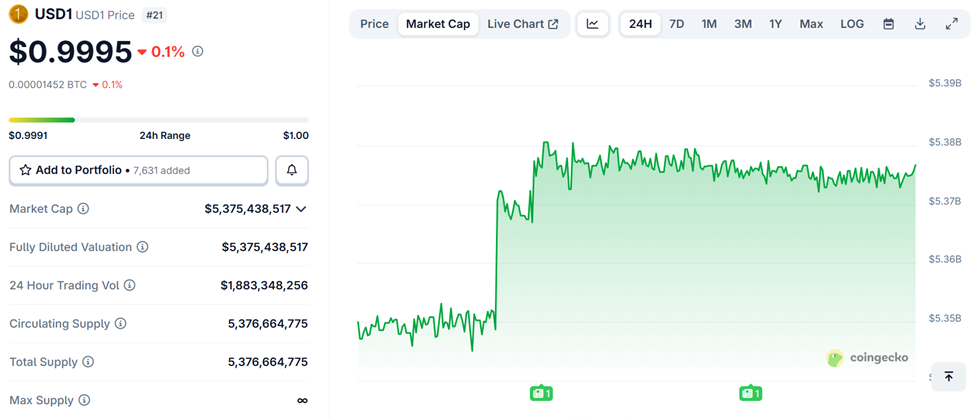 USD1 Circulating Supply. Source: CoinGecko
According to the report, this represents the highest single-exchange concentration recorded among major stablecoins. Blockchain analytics data from Arkham Intelligence corroborates this data.
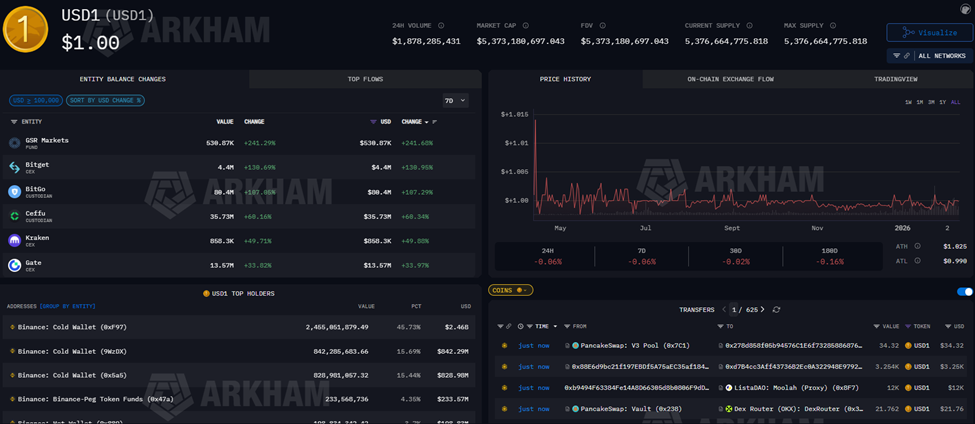 USD1 Concentration on Binance. Source: Arkham Intelligence
The findings fuel discussions about whether such a high level of concentration could create systemic risks or undermine the decentralization narrative often associated with stablecoins.
~87% of USD1’s circulating supply is sitting on Binance.
That’s the highest single-exchange concentration among major stablecoins, per Forbes. pic.twitter.com/yWjEtmRH1Z
Changpeng Zhao (CZ), the founder and former CEO of Binance, responded publicly to the debate, dismissing the concerns as overstated. In posts on X (Twitter), CZ argued that Binance historically holds large shares of many stablecoins simply because of its scale as the largest exchange.
“Binance (users) hold the largest % of most stablecoins (USDT, USDC, USD1, U … you name it) compared to all other CEXs. Not news,” wrote CZ.
Further, the Binance executive noted that when measuring centralized exchange holdings broadly, Binance typically accounts for roughly 60–70% across multiple assets.
If you only count CEX holdings, you will see Binance is about 60-70% across the board.
— CZ