
Bitcoin Multi-Year Lifeline Faces Critical Test as Supreme Court Weighs Trump’s Tariffs | US Crypto News
Welcome to the US Crypto News Morning Briefing—your essential rundown of the most important developments in crypto for the day ahead.
Grab a coffee. Bitcoin’s multi-year lifeline is on the line—not because of anything it did, but because of decisions being made in a courtroom far from Wall Street.
Crypto News of the Day: Supreme Court Ruling on Trump’s Tariffs Poised to Shake Markets and BitcoinBitcoin and risk assets in general face heightened volatility on February 20, 2026, as the U.S. Supreme Court prepares to issue its long-awaited ruling on the legality of President Trump’s 2025 tariffs.
The decision, expected at 10:00 AM ET, could have sweeping implications for trade, government revenue, and global markets.
The case, consolidated as Learning Resources, Inc. v. Trump and Trump v. V.O.S. Selections, Inc., challenges whether Trump had the legal authority to impose broad tariffs under the International Emergency Economic Powers Act (IEEPA) of 1977.
While IEEPA allows the President to address “unusual and extraordinary threats” to national security or the economy, it does not explicitly authorize sweeping trade tariffs.
Lower courts have twice ruled against the administration, setting the stage for the Supreme Court’s opinion.
Prediction markets suggest a high likelihood of illegality, with Polymarket pricing roughly a 26% chance that the Supreme Court will uphold the tariffs.
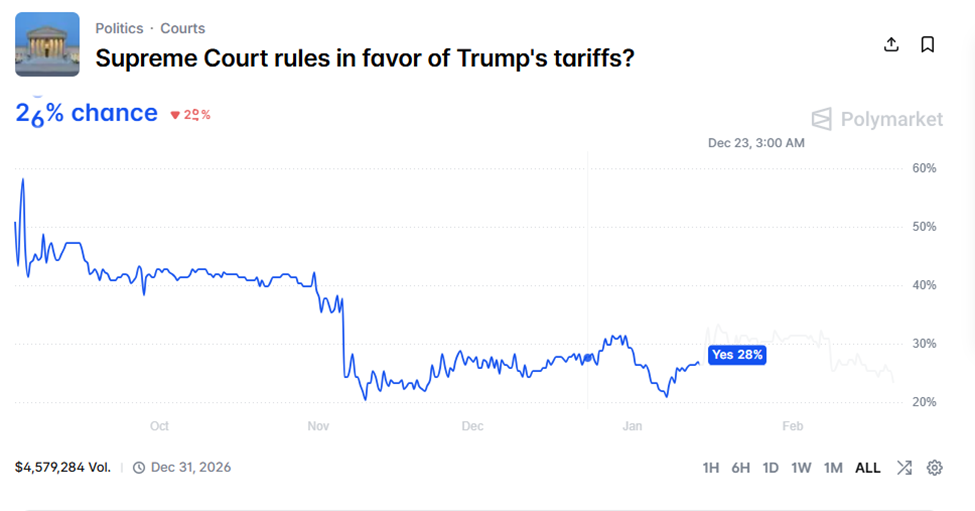 Odds of the Supreme Court Ruling in Favor of Trump’s Tariffs. Source: Polymarket
The odds are almost identical on prediction market Kalshi, where bettors wager on a 25.7% chance that the court rules in favor of Trump’s tariffs. Notably, crowd bets on Kalshi are gaining more authority of late.
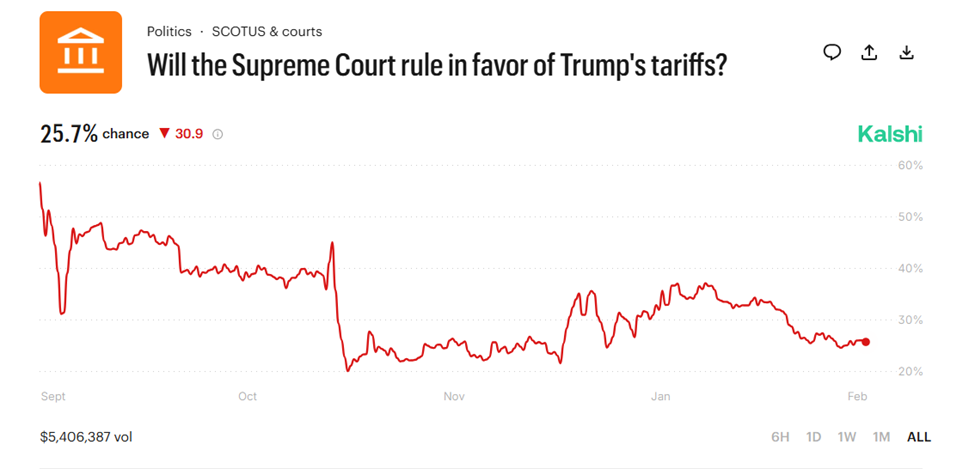 Odds of the Supreme Court Ruling in Favor of Trump’s Tariffs. Source: Kalshi
If upheld, tariffs would remain in place, potentially escalating trade tensions with Canada, the EU, China, and other partners. If struck down, importers could be entitled to refunds of duties collected since early 2025.
The $600 Billion Tariff Claim: Reality vs. HypeNotably, some media and crypto commentators have cited Trump’s repeated claim that his tariffs generated $600 billion in revenue. However, neutral analyses, including the Penn-Wharton Budget Model, place the actual exposure at $133–$179 billion, a fraction of the widely referenced figure.
Notwithstanding, even at these lower levels, the financial impact could ripple through markets, with traders anticipating “pure chaos” as markets price in:
- Potential refunds
- Emergency replacement tariffs, and
- Retaliatory actions from trade partners.